A MESSAGE FROM BUFFALO RAPID RESPONSE NETWORK
A MESSAGE FROM BUFFALO RAPID RESPONSE NETWORK Read More »
Buffalo Public Schools is preparing to permanently close two schools, and the district is framing it as unavoidable, a financial emergency, an enrollment issue, a matter of restructuring. If this pattern was not being repeated in cities across the United States it would have never piqued my interest, and anyone who has been paying attention to the way Buffalo operates, knows that school closures are rarely about “budget necessity.” They are about land, they are about real estate, and they are about political power and private interests positioning themselves for the next wave of development. The district claims a deficit of $80 Million dollars. The City claims a deficit of $70 Million. When New York State handed the Buffalo Bills $600 Million in subsidies, and Erie County handed over $250 Million in subsidies, (more money than needed to fix every school building, fund every community center, solve the transportation crisis, and stabilize the district’s finances,) it became clear that Buffalo’s priorities were not to provide resources for our citizens, but it was a political game for those in office using the city as pawn. Buffalo didn’t invest in the children they are planning to displace; they invested in the developers who will reshape the land once those children are gone. We handed $850 Million dollars to a billionaire without the consultation of any community… so why does BPS now have a committee for the closure of these schools? To give the perception to the community that they had a say in which schools will close, when all along they already know which two schools are on the chopping block. These are the transparent games and patterns they are counting on citizens being ignorant on. What’s happening now mirrors patterns we’ve seen in Chicago, Philadelphia, Detroit, and Washington DC where schools in “strategic” neighborhoods are shut down, the buildings are transferred or sold, and private developers reap the rewards. The communities who are almost always Black, Latino, immigrant, or low-income, are left with fewer public resources and less political leverage for their citizens. Buffalo is not an exception; it is following the script: starve public schools > declare them “unsustainable”> close them > transfer land > trigger development> displace the people. Behind closed doors, developers have been circling the city for years, especially the West Side, the Niagara Corridor, the Medical Campus expansion, the Waterfront, Broadway-Fillmore, North Buffalo, none of these are random areas. These are neighborhoods where property values are shifting, where institutional growth is accelerating, and where investors see long-term profit, and as development pressure increases, political incentives align accordingly. Now, as BPS claims it has “no choice” but to close two schools, the silence around which schools are under consideration is not accidental. This is strategic, because naming schools, triggers community backlash, legal challenges, union action, and enrollment flight. The district keeps the list secret while political leaders and developers continue to make quiet calculations about which buildings are most valuable, not educationally, but financially. Based on enrollment patterns, land value, and the political chatter happening behind the scenes, several schools stand out as likely targets. Here are MY guesses based on what I think is propelling this push. – School #90, Charles R. Drew Science Magnet, has long been in the shadow of the Buffalo Niagara Medical Campus. BNMC has been expanding aggressively, and the Fruit Belt’s land is among the most contested in the city. Closing School 90 clears the way for medical expansion, biotech labs, housing developments, or institutional partnerships, even government institutions looking for new buildings, like the proposed Veterans Specialized Services branch they wanted to build by the Fruit Belt. It benefits Kaleida, Roswell, BNMC, and the network of private developers aligned with them, not the families who have already endured decades of displacement. – School #95, Waterfront Elementary, is another high-value target. This building sits steps from Canalside and the Outer Harbor, in the heart of one of the most profitable development zones in Western New York. Waterfront land is scarce, and elected officials have never hidden their desire to transform every inch of the district into mixed-use commercial and residential space. Closing the school frees up land that developers have been eyeing for years. Especially now as other projects in the area have been halted. On the West Side – Schools #3 #30 and School #82 sit in neighborhoods experiencing heavy gentrification pressure. As housing prices rise and new construction projects spread across the Niagara Street corridor, school buildings become prime real estate for apartments, luxury rentals, and commercial expansion. School #3 sits on THE HOTTEST CORRIDOR with heavy development. These closures have nothing to do with education, and they have everything to do with profit. If Buffalo is serious about equity and sustainability, it would invest in the schools it threatens to close, and it would stop selling off neighborhoods in the name of “revitalization.” When public land becomes a political bargaining chip, children become collateral damage and cities become the chess board of politicians and their donors. School closures are not neutral decisions, they are political acts with long-term consequences, and in Buffalo, those consequences are already unfolding. Buffalo is in the middle of a real estate transformation that most residents have not been invited into. Behind the press releases, the committee meetings, the political speeches, a larger machine operates. The gears are made up of real estate developers, powerful institutions, political donors, and elected officials who have quietly sold Buffalo marginalized neighborhoods as disposable. I keep hearing people say they are not interested in politics, sadly, politics is interested in YOU. #daniaisonherbullshitagain #buffalopolitics #BuffaloStrong #publicschools #developers https://www.wkbw.com/news/local-news/buffalo/absolute-financial-necessity-bps-moves-forward-with-plan-to-potentially-close-two-schools?fbclid=IwdGRjcAOdiQpjbGNrA52IiGV4dG4DYWVtAjExAHNydGMGYXBwX2lkDDM1MDY4NTUzMTcyOAABHiq7qSFifM4n85JhKdsu1Ce8jZK1izkKNad-xcWb7vuJeK6XVcPOH_cITV8D_aem_tzq63uF8vZK3D-K9EcJ66g
The Public Schools and Politics Read More »
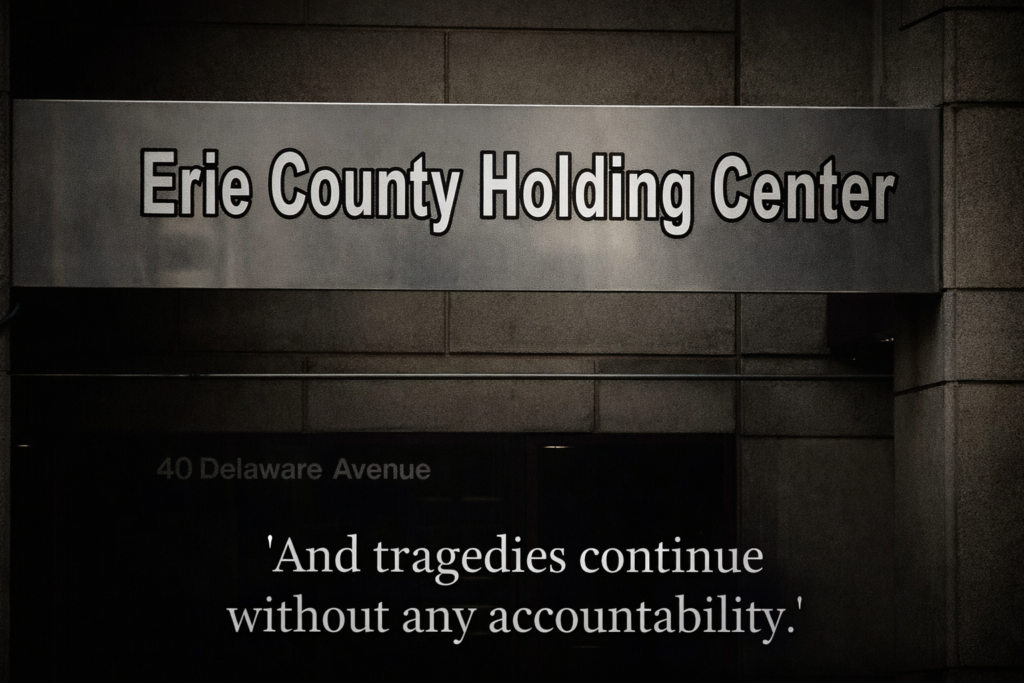
THE CHOKEHOLD OF CARCERAL FINANCE ON WESTERN NY By Eri Alvarado, Veteran (X-Marine) Pattern recognition is the foundation of understanding how society works, and how people function within the predetermined framework. I could not help but recall the raids that happened in Buffalo and the surrounding areas from 2016-2018, and the communities most affected. Back in October of 2016 ICE raided local Mexican restaurants that were crowded community hubs, hiring community members and providing stability to local Mexican community. The four local restaurants were Don Tequila, El Agave, Agave, and La Divina Mexican Store owned by Sergio Mucino. There was a deafening silence from our elected and community leaders then that I cannot help but compare with the silence of recent raids. The violent ICE raids in Western New York mirror the region’s history of incarceration, surveillance, and federal dependency. This relationship is not an anomaly, it is a continuation of a long-standing pattern where the region stabilizes its economy by hosting institutions of control, prisons, detention centers, law-enforcement hubs, and federal enforcement operations. This pattern dates back to the collapse of Buffalo’s manufacturing economy, when policymakers failed to rebuild industry and instead leaned into carceral infrastructure as an economic replacement. When Bethlehem Steel and other major employers collapsed, WNY needed new sources of stable employment. Instead of reinvesting in innovation or economic diversification, leaders turned to State prisons in rural counties, federal law enforcement offices, ICE detention and processing, Sheriff expansion and jail expansions. This shift was not ideological; it was economic because control became profitable. The ICE detention complex mirrors the earlier prison boom and follows the old template. Rural towns get jobs, politicians get union support, counties get federal money, local businesses get contracts, so WNY uses detention the way it used incarceration, as a jobs program masquerading as public safety. Buffalo invested heavily in the Regional Intelligence Center, license plate readers, and police & ICE data partnerships because surveillance networks bring federal grants, equipment upgrades, cross-agency contracts. ICE feeds this system with intelligence sharing, warrant collaboration, data integration, and surveillance becomes the “new economy,” replacing manufacturing with state monitoring. Using the immigrant community as an economic commodity and profiting from detaining immigrants, transferring immigrants, surveilling immigrants, running federal operations targeting immigrants, and politicians avoid acknowledging this because it exposes a devastating truth that immigrant suffering has become a quiet and easy economic stabilizer. Buffalo’s legacy of segregation and exclusion through redlining, racist housing policies, police expansion, neighborhood surveillance, it all aligns perfectly with ICE’s current operational approach. ICE isn’t an outsider it fits Buffalo’s existing socio-political DNA. This system prevents WNY from building industries rooted in innovation, supporting immigrant entrepreneurship, fostering multicultural growth, and attracting global talent. ICE has become the economic crutch politicians use instead of doing real work, WNY’s political economy treats control as currency, Western New York has quietly built an entire economy around ICE, an economy that relies on detention, surveillance, and fear. Politicians won’t admit it, because it exposes their hypocrisy, but the truth that in this region, immigrant suffering has become a business model. Every detained immigrant means federal money, every transfer means overtime, every partnership with ICE means new vehicles, new equipment, new budgets. And when you follow the money, you understand why BOTH parties defend ICE behind closed doors, even the ones who claim to be progressive. Western New York’s political class hides behind speeches about inclusion while protecting the very systems that criminalize not only immigrants, but all of our citizens. They benefit economically and politically from militarized police and the presence of ICE; while telling the public they have nothing to do with it, and their hands are tied to addressing the issues. This is not an enforcement issue, it is not a public safety issue, this is an economic dependency created by politicians who chose control over development and fear over opportunity. Buffalo deserves better than an economy built on incarceration and immigrant families deserve better than being treated as federal reimbursement slots. Our region deserves leaders who stop hiding behind ICE, the military industrial complex, or fearmongering designed to create chaos to legislate funds into the hands of donors. They deserve leaders ready to build an economy rooted in dignity, creativity, and real opportunity for those they have been entrusted to represent and protect. Until then, ICE will remain the political business tool meant to subjugate and another glaring example of our moral failure as a society. For information: 716-370-8880 dtunmoreld2@gmail.com
THE CHOKEHOLD OF CARCERAL FINANCE ON WESTERN NY Read More »