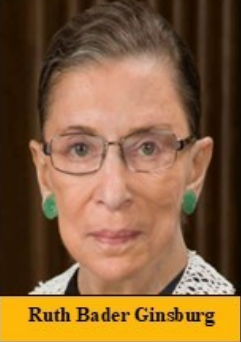
by Virginia McIntyre
Affectionately called “R.B.G.” by her supporters,
Ruth Bader Ginsburg has inspired generations of women to break gender barriers. Even after facing gender discrimination as she pursued her academic goals, Ginsburg forged ahead and became the second woman –and first Jewish woman–to serve on the Supreme Court.
President Clinton appointed Ruth Bader Ginsburg in his first appointment to the Supreme Court to replace retiring Justice Byron White. Ginsburg had been the cofounder of and chief litigator for the Women’s Rights Project of the American Civil Liberties Union (ACLU).
This career provided her with the experience of arguing six cases before the Supreme Court, all dealing in some way with gender discrimination. President Carter appointed Ginsburg as a judge to the U. S. Court of Appeals for the District of Columbia Circuit in 1980, where she served for thirteen vears. She was confirmed by a 96-3 vote in the Senate
Ruth Bader Ginsburg was borm on March 15, 1933, in Brooklyn, New York. Born to a Jewish family, her father Nathan Bader immigrated to the United States, while her mother Celia Amster Bader was a native of New York.
Ginsburg’s family valued education and instilled in her a love of learning.
She attended P.S. 238 for elementary school and James Madison High School in Brooklyn before continuing to attend Comell University.
Ginsburg graduated from Comell with a bachelor’s degree in 1954, earning high honors.
That same year, she married Martin D. Ginsburg, and the couple had two children together.
After graduating from Cornell, Ginsburg subsequently started attending Harvard Law School.
While at Harvard, Ginsburg was one of only 9 women in a class of 500 students.
She often faced gender discrimination and was asked to explain how she felt about taking a spot in the program instead of a man.
Ginsburg and her female colleagues were called on in class for “comic relief” and they were even excluded from using certain sections of the library.
Ginsburg transferred to Columbia Law School in 1958 for her final year because her husband received a job in New York
City.
During her studies, she did both the Harvard and Columbia Law Review. Ginsburg graduated with her law degree from Columbia in 1959 at the top
of her class.
However, it was hard for her to find employment after graduation.
She explained, “In the fifties, the traditional law firms were just beginning to turn around on hiring Jews….
But to be a woman, a Jew, and a mother to boot, that combination was a bit much.”
This trailblazer accomplished much in her lifetime. The list is long. Let us all strive to be like
her.. The Clinton Presidential Library has released a Freedom of Information Act (FOIA)
collection conceming Justice Ginsburg’s nomination and confirmation to the Supreme Court.