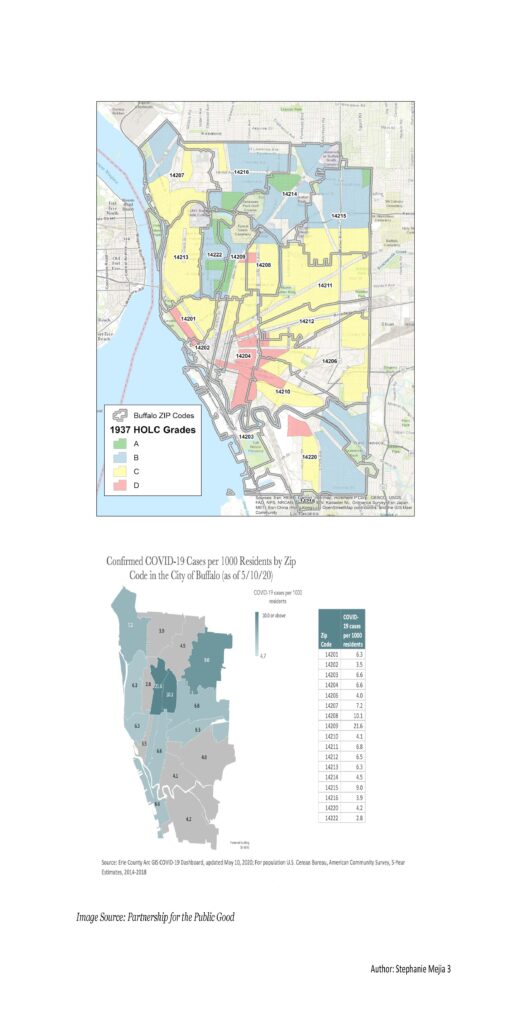
Image Source: Partnership for the Public Good
The areas mentioned above are referred to as “historically excluded areas” because that’s exactly what they are – an area that has been historically ignored and prevented from easily accessing opportunities to grow. More specifically, historically excluded means the systemic marginalization of certain groups using laws and policies to limit things such as economic opportunity or societal power. The West Side, an area predominantly composed of BIPOC residents, is a strong example of the effects of historical exclusion as it was impacted during COVID-19/by COVID-19 at a higher rate compared to areas that are not historically excluded. An example of early historical exclusion is redlining, which was a tactic used beginning in the 1930’s and continued to the 2010’s in Buffalo to segregate areas by social and racial class to maintain their value.
This was a popular tactic used in the City of Buffalo to disenfranchise certain ethnic groups. The Federal Housing Association developed a system to categorize different neighborhoods with ratings from A-D, used to alienate Black and immigrant households by ensuring they remained in specific neighborhoods with limited social mobility and growth (United States Federal Housing Administration, 1936, p. 198). Green, or Grade A, was considered “best” and often used for White and higher-income communities. In contrast, red, or Grade D, was considered “hazardous” and often used for BIPOC and lower-income communities. So, why the history lesson? Because it’s important for our Latino/Hispanic community to understand where we are living and how the past policies made by discriminatory parties have impacted our ability to grow. I can write a book on how it has impacted our health, housing, school system, roads, etc., but the main thing I want to address is how our ability to build community is weak, almost non-existent, compared to other areas, and how we can easily start to remediate that.
The segregation we experience in our city is man-made, policy by policy, and brick by brick. Systemic racism impacts more than how much funding or attention an area gets, but it impacts our ability to connect. Because what is stronger than separating people by zones or streets? Convincing them that the separation is “natural” and “normal.” As a Latina, it is in my bones that community and connection is natural – not this separation of communities based on “sides” or spaces.
I am confident that we can improve our current community by taking steps to connect us more with our neighbors. Here is a quick step-by-step guide that anyone reading can use to create or strengthen the community they live in. It does not require funds to build community, but it does require time and willingness to step out of our comfort zones. It might be awkward at first but trust me when I say that it will become natural (especially for us Latinos) after we take the first step of saying “Hi, I live across the street.”
How to Build Community
1. Introduce yourself to your neighbors – The one next door, the one across the street, or the one around the corner. A simple “Hello, I’m in your neighborhood” is enough, and from there you can build a relationship. Maybe the next conversation is about their garden, bulk trash day pick up, or a mutual dislike of how long it takes the street to get plowed.
2. Share Information – Heard that street parking days changed? Let your neighbor know. There’s a new compost program for city residents? That neighbor around the corner with the new vegetable garden might love to hear about it. A neighbor has landlord who is refusing to make safety repairs? Connect them with a local organization fighting for tenant rights.
3. Share Resources – Yes, a cup of sugar can go a long way or maybe even some clothes that no longer fit your kids but might fit your neighbors. An elderly neighbor might need hand-shoveling – a quick shovel of their front porch is something they will for sure appreciate. Sharing items like tools or exchanging services is a great way to build community (my neighbor borrows our mower and he in turn snowplows our driveway).
4. Create Other Lines of Communication – When you are ready, sharing contact information is a great way to build trust and other lines of communication. This is especially helpful for when emergencies happen, especially weather-related ones like the Blizzard of 2022. We can keep ourselves and our neighbors safe by just checking in on each other and making sure we each have everything we need. Heat is out for your neighbor across the street? Offering your home for warmth may save their life.
5. Sharing Privilege– Yes, we all have privileges we can share with others. Some have the privilege of knowing how to access 311 as a resource (and maybe even the privilege of having the language skills to do so), so helping a neighbor call to file a report is using your privilege efficiently. Some of us have the privilege of status, where our undocumented neighbors might be scared to carry out daily tasks like getting groceries. Going grocery shopping for those who do not feel safe leaving their homes or going out in public is a privilege that can go a long way.
This work on relationship building creates capital, which is vital for community development. When you do not have the money to make structural changes, you use social capital. The larger your network, the more empowered you are to make change. But when you live in a city built to separate, not many are used to crossing lines to build relationships and, therefore, capital. So, here is your push, the go ahead you needed to introduce yourselves to that neighbor you always see a few houses down. And yes, building connections will strengthen our capital, but I believe the best part of growing our Latino community is that more than just our community will reap the benefits in the end.
If you see me in the neighborhood walking my dogs (perro salchichas), please don’t hesitate to say ¡Hola!
 4
4
 0
0