
By Rocco Anastasio
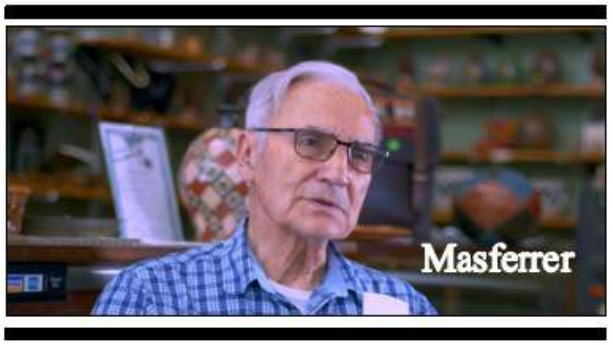
This past month, I had the honor of sitting down with Mr. Masferrer to film an episode of Buffalo Latino Lens.
At the age of 85, his story as a former political prisoner under Chilean dictator Augusto Pinochet is one of incredible resilience and inspiration, however, Santiago Masferrer doesn’t see himself as a hero.
Yet if you step into El Buen Amigo, a Latin American artisan shop and cultural center nestled in Buffalo’s Allentown neighborhood, you’11 feel the presence of someone whose life has been devoted to justice, dignity,and community.
Masferrer arrived in Buffalo on April 28, 1977, after enduring 22 months in a concentration camp and six months in solitary confinement Rocco Ana sta sio under the brutal Chilean dictatorship of Augusto PinoMasferrer chet.
He was 34 years old, a father of two, and deeply scarred-but not broken. “It was a gift,” he said with quiet conviction. “A tough experience, but I took the good from it.” The trauma didn’t end with his release. Back in Santiago, as he worked with a Catholic resettlement program and scavenged for recyclables to survive, the regime’s secret police began harassing his wife. The couple made the painful decision to flee Chile and rebuild their lives in Buffalo.
He started from the ground up- literally – working as a janitor at Millard Fillmore Hospital, taking classes at the University at Buffalo, eventually eaming his degree and later teaching carpentry at Attica Correctional Facility.
Masferrer’s teaching wasn’t about punishment or control. “The keyword is respect,” he says. “They respected me, and I respected them.” His hands-on educational program at Attica helped drop recidivism rates among his students to a staggering 11.4%, compared to the state average of 60-70%.
Yet Santiago’s most visible legacy lies in El Buen Amigo, which he and his wife have sustained as volunteers for 48 years.
The shop began with Chilean crafts woven by widows of the disappeared and by political prisoners -and has since grown to represent artists from nearly every Latin American country. Sweaters, carvings, paintings, jewelry – each object holds a story, a people, a struggle.
“This is a Christian mission.” Santiago explains. “but not the kind that only talks the talk. The walls of El Buen Amigo have welcomed poetry readings, cooking classes, dances, and art exhibitions. Field trips and internships have brought hundreds of students into contact with the richness of Latin American culture. A Spanish language program continues to serve professionals and community members alike -social workers, professors, police officers, and doctors – all coming to leam not just the language, but the values Santiago holds dear.
There’s a quiet nobility in Santiago’s voice, a deep, unwavering sense of purpose rooted in faith and history. “If we don’t stand for what we believe, we will lose this country too,” he says. His distrust of politics is firm, yet he makes no apologies for his activism. “I don’t want to kiss anyone’s ass,” he says. “I have my dignity. I have my values.” One anecdote stands out. A man once stole a sweater from El Buen Amigo. A year later, he retumed -not just to pay for it, but to apologize.
He had come to understand what the shop really was: a volunteer-run, community-supported mission grounded in sacrifice and service. He Bue migo placed $50 on the counter. “That was one story, Santiago says. “We have 100 more like it.” Despite decades of hardship, Santiago never lost sight of his roots- or his hope. Born to a family of mixed Mapuche and European descent in a poor neighborhood of Santiago, he holds dear the values of Latin America’s tri-racial heritage – Indigenous, African, and European.
He reminds us that Chile abolished slavery in 1810 and that. five generations later, the legacy of those people lives on in the fabric of Latin American identity. Masferrer continues to mentor, educate, and inspire. He speaks of heroes: Mandela, Mother Teresa, Malcolm X, Monsignor Romero, and insists the next generation must step forward to carry the torch. “We need more peacemakers,” he says. “More people who give, not take. Who build, not destroy.” El Buen Amigo is more than a store. It is a testament. A cultural haven. A quiet revolution led by a man with no fear and an unbreakable belief lief in human dignity. As Santiago said at the end of our interview, “If you respect your neighbor, you have peace.” And in that, he’s given Buffalo-and the world -a path forward.
Follow Buffalo Latino Lens for more stories on local changemakers. www.buffa lo la tinolens.com/ https:// www.facebook.com/BuffaloLatinoLens https://www.instagram.com/buffa lolatinolens/
Read More From This Writer
- All Post
- Art
- Books & Poems
- Business
- Column
- Community
- Community News
- Education
- Entertainment
- español
- Food & Culture
- Health
- Interviews
- Media
- Military & Veterans
- Music
- Peace
- People
- Photography
- Politics
- Sports
- Technology
By Rocco Anastasio I’ve always believed that travel does something more than just take us to a new place. If...
By Rocco Anastasio This past month, I had the honor of sitting down with Mr. Masferrer to film an episode...
It’s been a while since I’ve written about my film “Boricua Soy Yo.” However, over the last few weeks, I’ve...